Sunday, February 22, 2015

Venus In Fur

Just closed Venus today - I'm really going to miss it almost as much as I'll miss working/playing with Lucas and Laura.

Here's the review:

With ‘Venus in Fur,’ Shaker Bridge Plumbs Desire and Power 
By Nicola Smith
Valley News Staff Writer
Thursday, February 12, 2015 
(Published in print: Thursday, February 12, 2015)


Venus in Fur, the tantalizing, entertaining play-within-a-play by David Ives now at Shaker Bridge Theater in Enfield, is one sure way to shake off the winter blues.

To say it’s a play about sex, power and domination makes it sound more heavy-going than it is. It begins as a screwball comedy — a tightly-wound, buttoned-down man meets a free-spirited blonde bombshell — but the stakes, and the tension, ratchet up as Ives introduces layers of complication and provocation.

Venus in Fur is an intimate conversation between two characters, two actors, but it’s also a play about the dichotomy between the way we present ourselves publicly and privately. And it’s about the deep-down needs, which aren’t always necessarily sexual and not always articulated, that we may not acknowledge to ourselves, but which other people can see in us.
Ives based his play on the erotic novella Venus in Furs, published in 1870 by the writer Leopold von Sacher-Masoch, who put the “masoch” in “masochism,” and whose name sounds like something dreamed up by Mel Brooks.

Sacher-Masoch was born in the Austro-Hungarian empire in the city of Lemberg, now Lviv in the Ukraine. His novella follows the amorous exploits of dreamy, sensitive intellectual Severin von Kusiemski, who becomes enamoured of Wanda (pronounced Vanda) von Dunajew, a woman of great intelligence and beauty. As they become involved, Kusiemski begs her to enslave him, which she happily does. He derives sexual pleasure from her dominance, but also feels the sting of her cruel indifference to him. The more submissive he is, the harsher her treatment, and the more exquisite his agony.

Ives’ play begins in a shabby New York audition room . Thomas, a writer and director who’s adapted Venus in Furs for the stage (Ives drops the last “s” in his title), complains on his cellphone to his fiancée that his efforts to find the right woman to play Vanda have been unsuccessful; the only actresses who have read for him, he says, are dim-witted and unprepared, with Valley Girl vocal mannerisms — and vulgar, to boot.

Thomas, played by a fine Lucas Van Engen, is the kind of New York intellectual who plays as a series of clichés: high brow, pompous and condescending. Beneath that, though, is an earnest idealist, and a man perhaps stifled by the very intellectual constructs to which he pays homage.
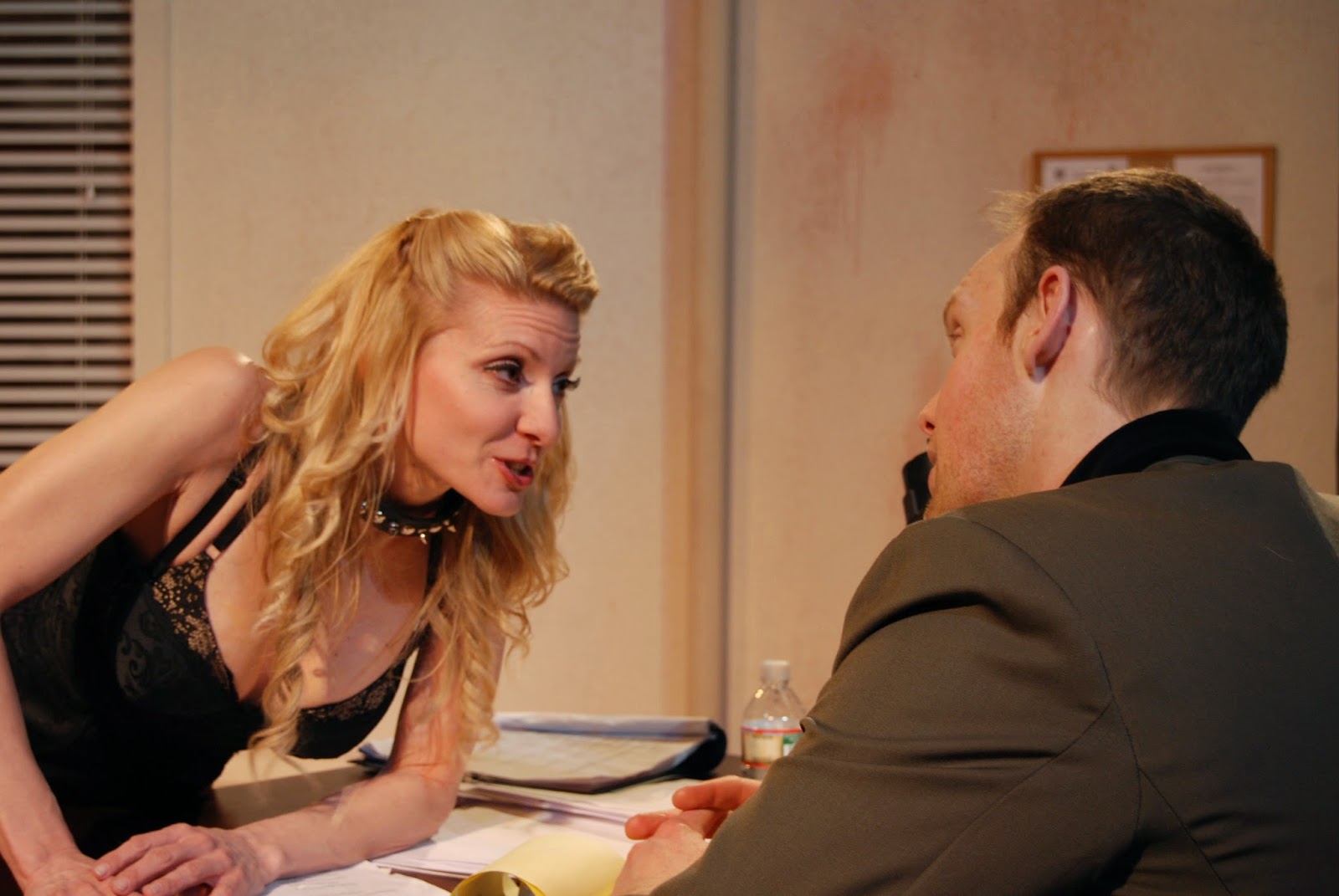
Just as Thomas has given up auditioning for the day, there’s a knock on the door. Enter real-life actress Vanda, played by a charismatic Laura Woyasz, swearing and talking a mile a minute, dragging in shopping bags and an umbrella. Flustered because she’s late for the audition, Vanda begs a reluctant Thomas to let her have a shot at a reading. Ives has fun introducing dramatic moments, such as Vanda’s entrance, with claps of thunder, as if we were watching a campy melodrama.

Thomas is tired and frustrated, and wants only to go home. He tells Vanda that he’s finished auditioning. In truth, she seems no different from the women he’s already sent on their way — clueless, and lacking an artistic aesthetic.

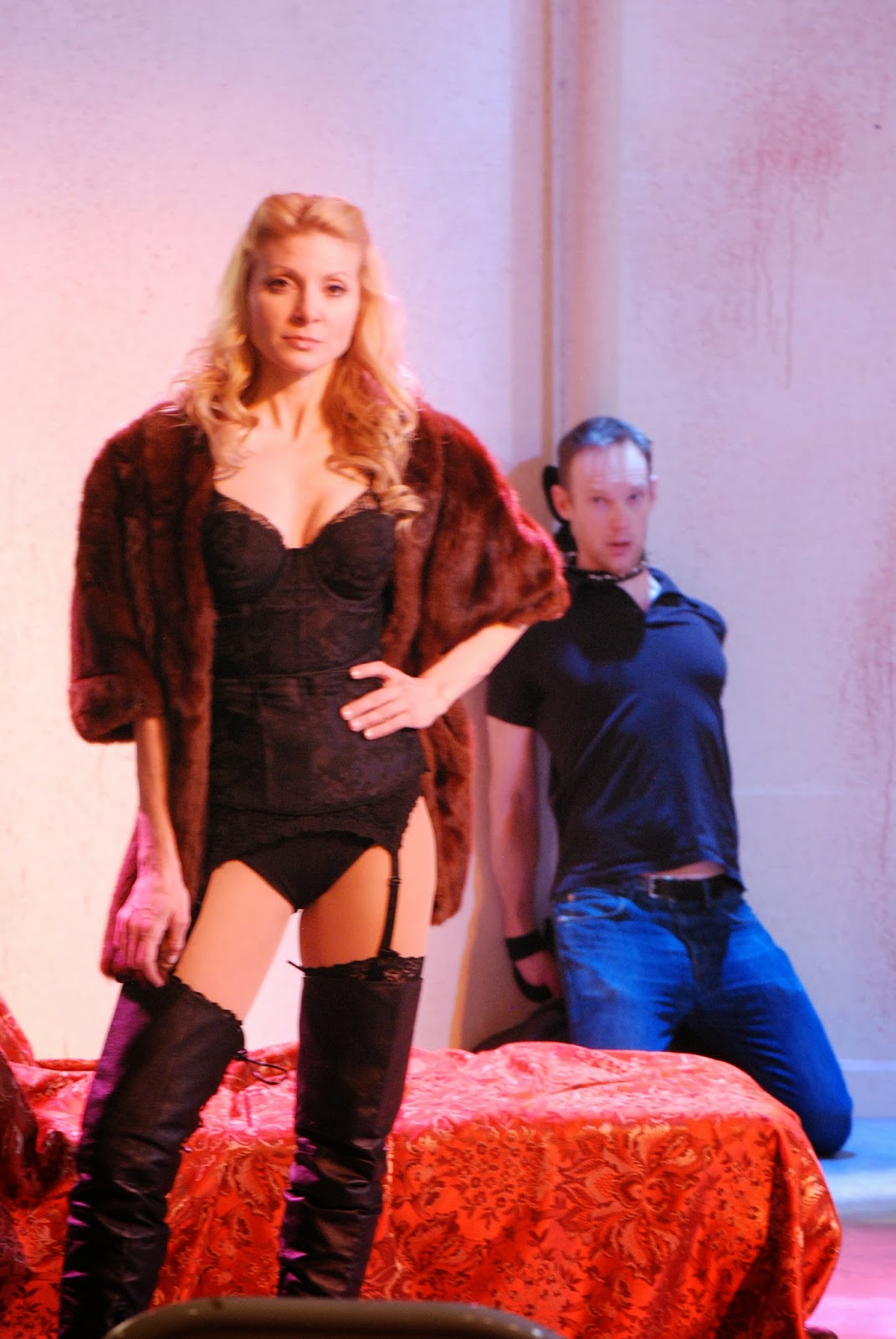
But Vanda is undaunted by his dismissiveness, and insists on reading for him. Isn’t it fate, after all, that she happens to have the same name as Sacher-Masoch’s heroine? And look! When she whips off her trenchcoat, she’s already dressed for the part, in black corset, garter belt and boots.
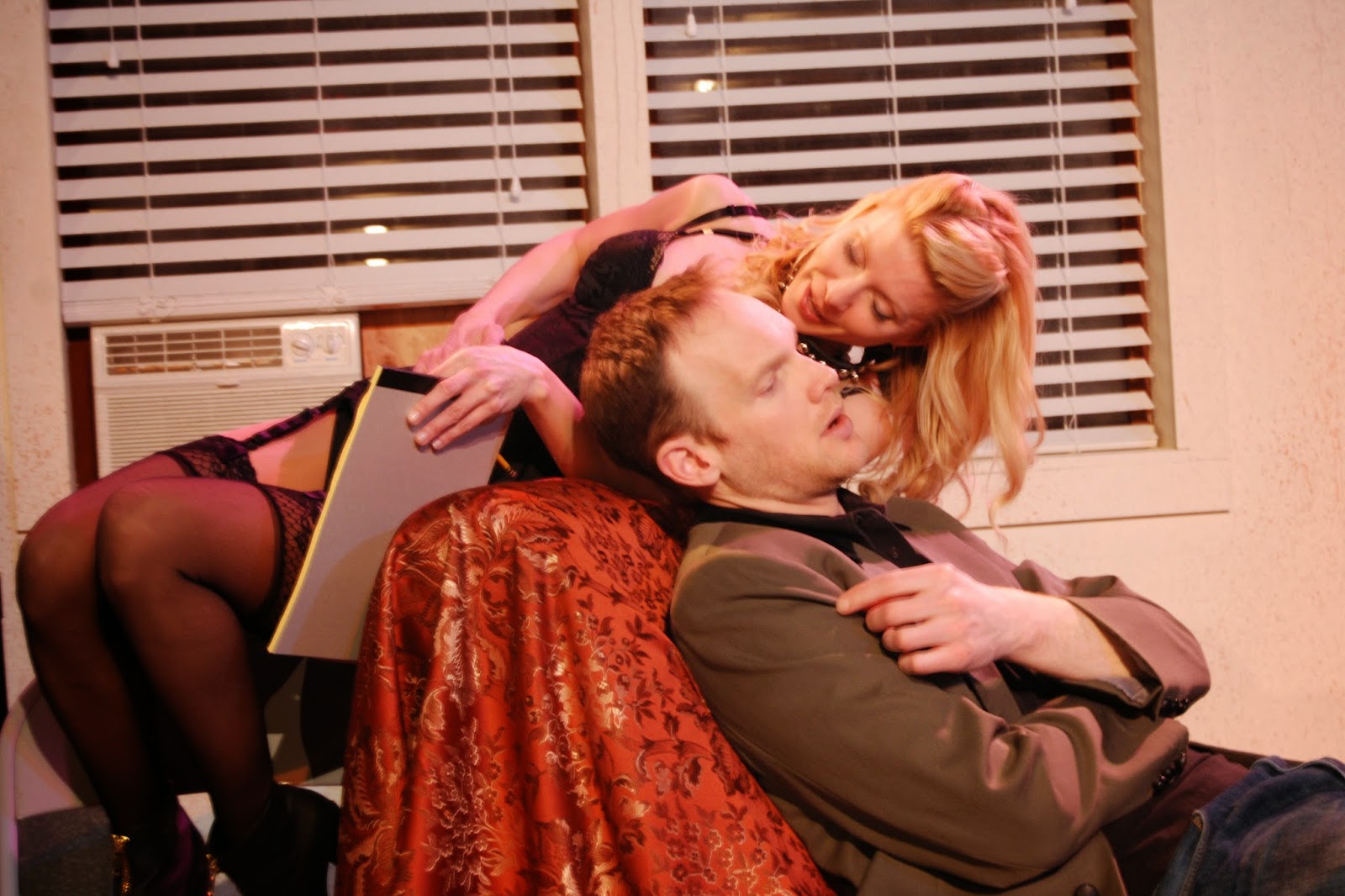
The moment Vanda starts reading her lines, Thomas is startled by her transformation into a poised, steely European aristocrat. And as Thomas and Vanda act out his play, with Vanda coaxing and flattering him into playing Severin (not much persuasion is needed) the balance of power shifts.
Vanda, who has been comically self-deprecating and charmingly flirtatious, begins to exert intellectual independence, poking fun at Thomas’ reverence for Sacher-Masoch’s prose, which, if you take a spin through the novella, has moments of acute insight into sexuality, but which also can read as if Anais Nin were being parodied by P.G. Wodehouse.

Ives takes this trope of the man at the mercy of a cruel woman and reimagines it. He respects the original, with its lengthy considerations of the nature of desire, but takes it further by examining the dynamics of power in more modern ways: The power of a director over an actor, the seduction of director by actor, the power of lust and imagination.
“You don’t have to tell me about sadomasochism; I’m in the theater!” Vanda jokes with Thomas, which gets a big laugh.

Isn’t Venus in Furs really just a hackneyed view of women, Vanda demands of Thomas. To cite one gem from the novella: “Despite all the progress of civilization, women have remained exactly as they emerged from the hand of Nature.”
Thomas protests but Vanda begins to, metaphorically, undress Thomas, probing his weaknesses and responding with increasing fury when she feels he’s dissembling.

Thomas realizes that this Vanda isn’t the same woman who walked in the door. But who is she exactly? How does Vanda understand the play so well, if she’s as untutored as she claimed to be? Why does she seem to know so much about Thomas’s fiancee Stacy, pegging her, accurately, as the same kind of uptight intellectual he is? Is Vanda’s intention to seduce or punish Thomas?
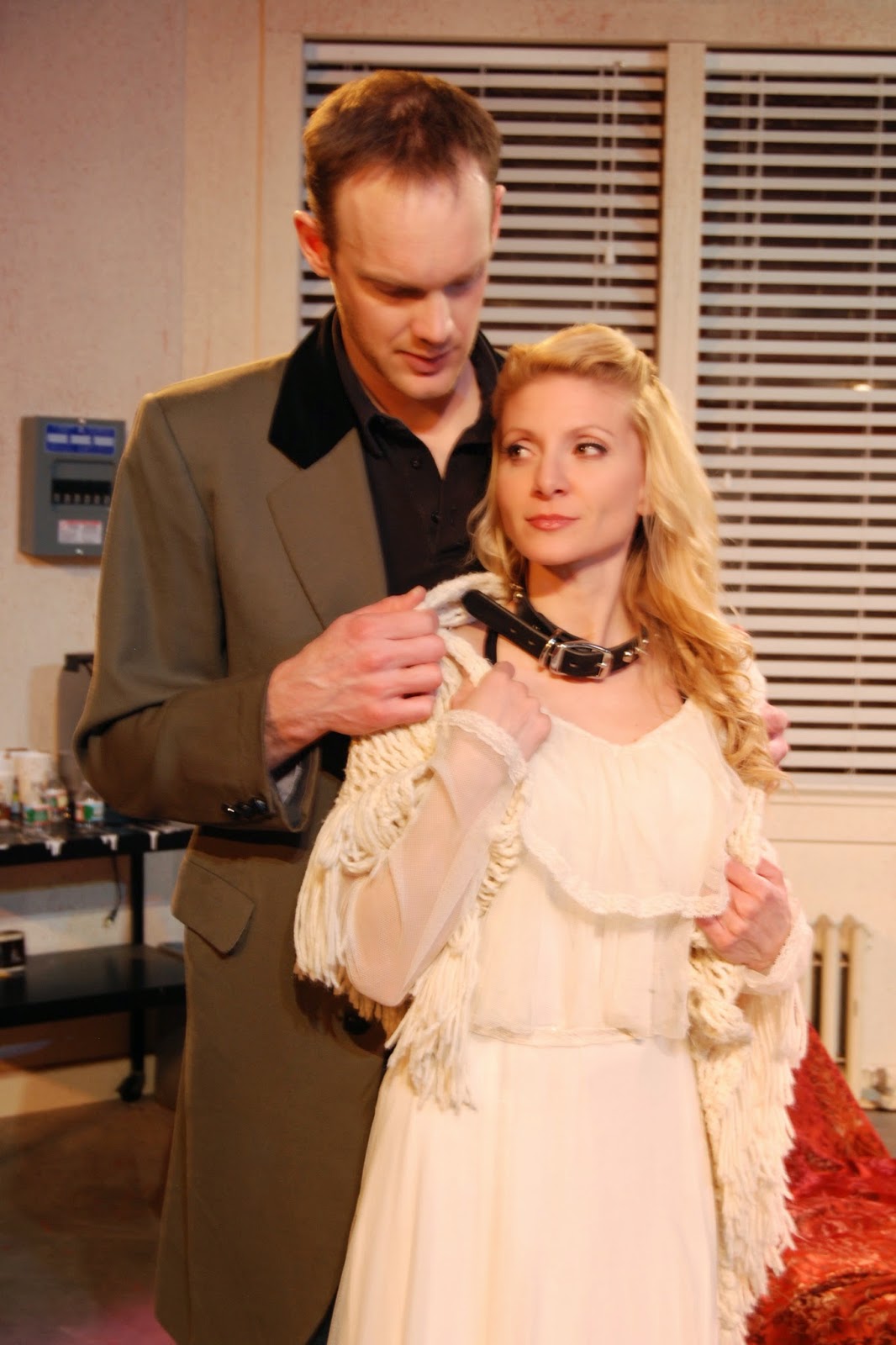
As the atmosphere intensifies, Vanda commands Thomas to dress her, just as Wanda commands Severin. The air is taut with erotic tension, of gratification delayed.

Bill Coons, the artistic director of Shaker Bridge Theater, has done a fine job with the actors playing Vanda and Thomas, balancing sensuality with laughter, and vulnerability with control.

Woyasz bursts on stage with the physical comedy of a Judy Holliday or a Goldie Hawn, exuding ditziness and likeability. She’s dynamic on stage, deft at comedy and commanding in the moments that call for a volatile toughness.
As Thomas, Van Engen strikes the right notes of the aspiring artist who wants to be taken seriously, but is also afraid that his life, when the facade has been dismantled, is something of a fraud.

The play ends on an ambiguous note (another point of comedy in the play: the distinction between “ambiguous” and “ambivalent”), with Thomas poised on the precipice of ... what exactly? Revelation or destruction? We’re not sure. The ending is a bit of a let-down after the rapid verbal volleys that have preceded it, but the playful comedy throughout more than compensates.

Venus in Fur continues at Shaker Bridge Theatre in Enfield’s Whitney Hall through Feb. 22. Tickets are $32, $25 for students with ID. For information and tickets call 603-448-3750 or go to shakerbridgetheatre.org.


Nicola Smith can be reached at nsmith@vnews.com.


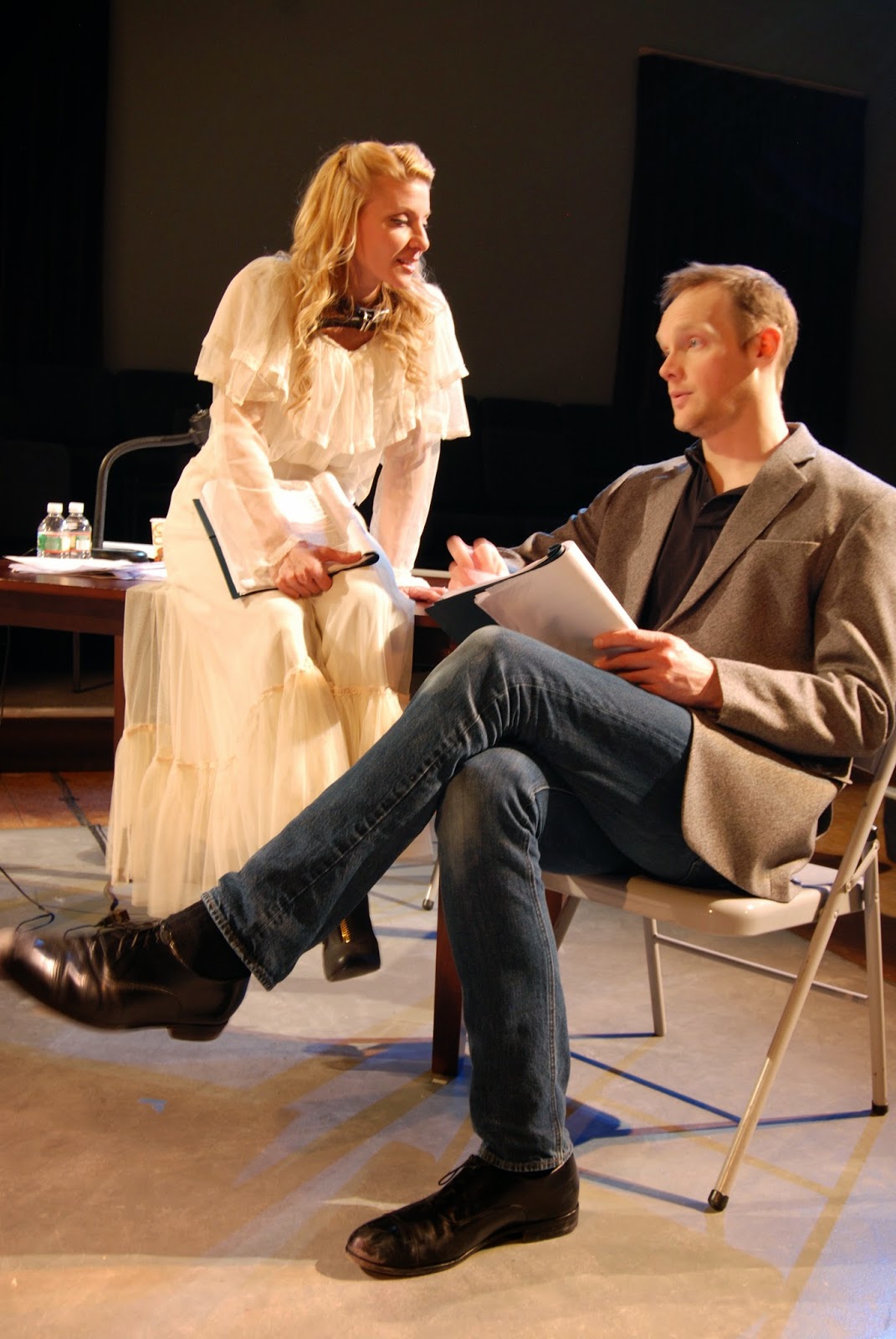
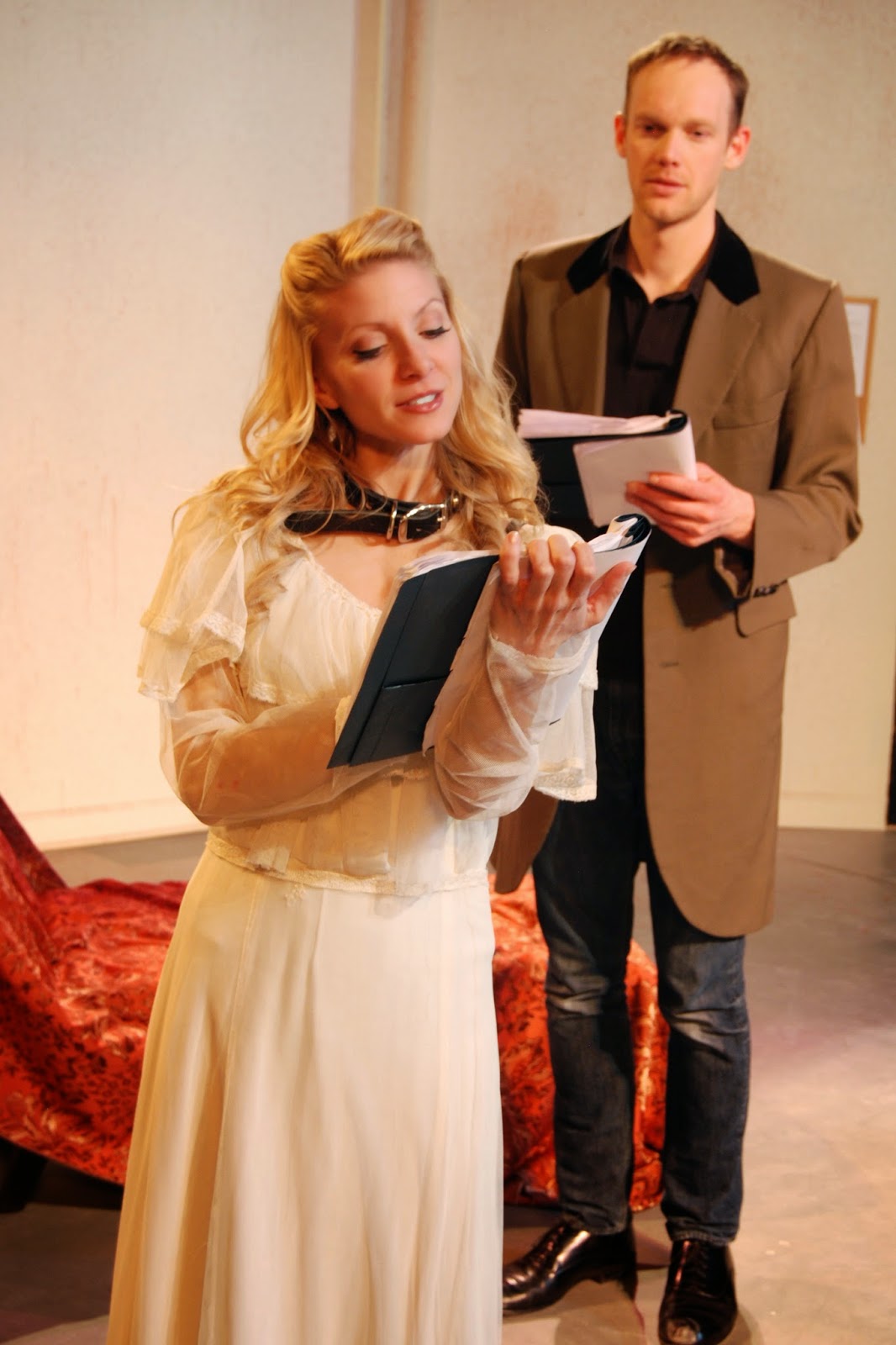
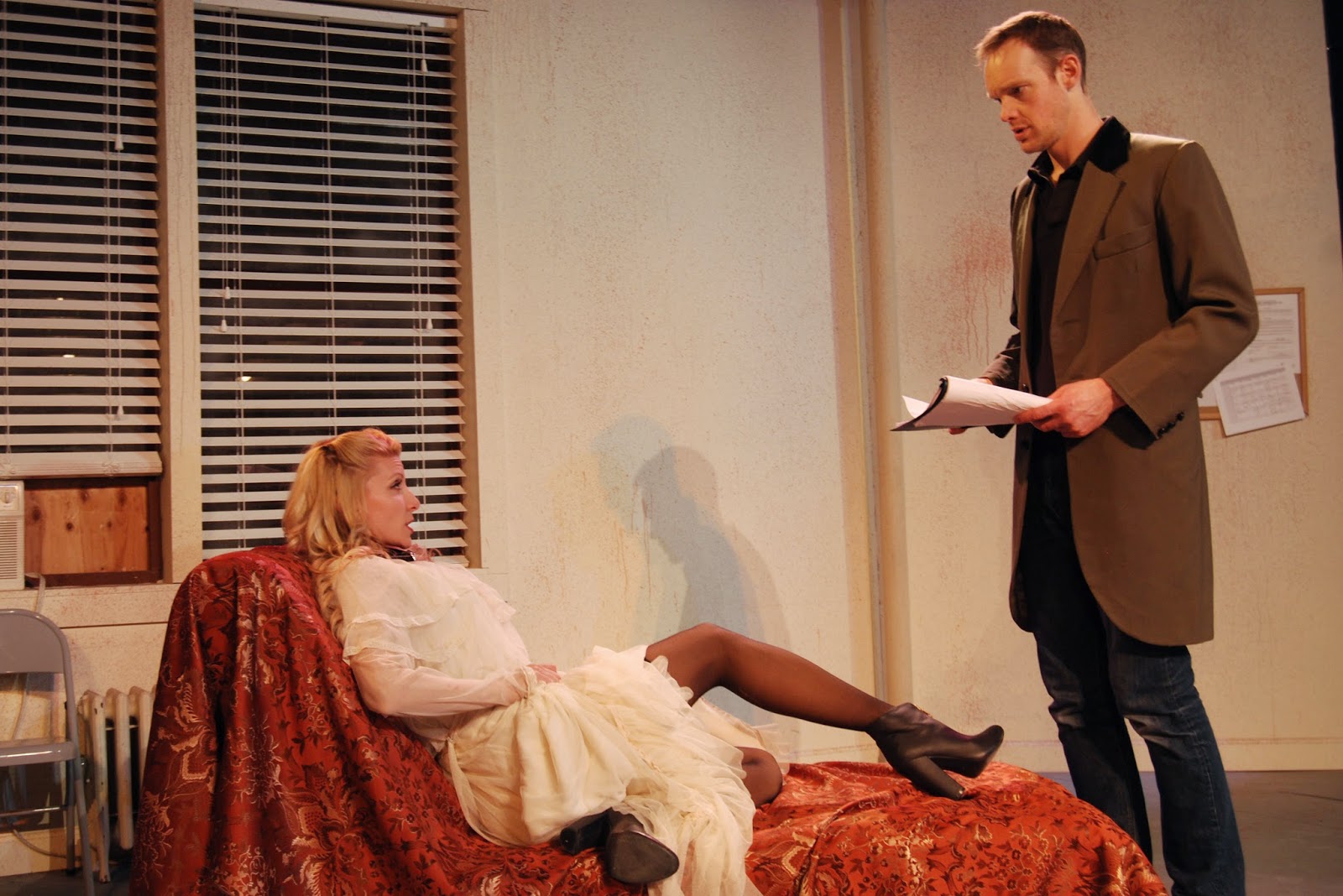
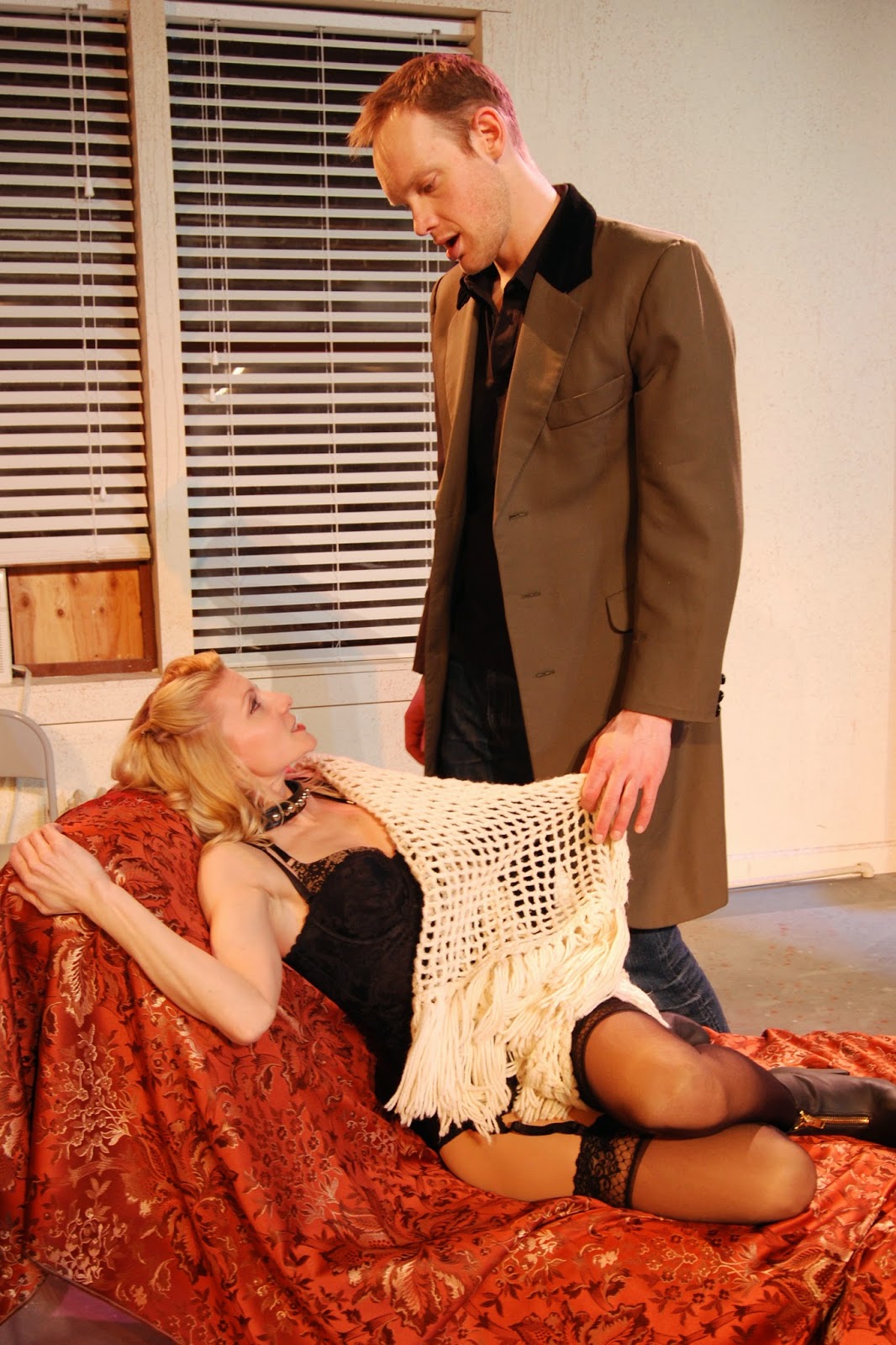
And here are some photos from the production:


Am I late? Fuck!
If you will?


Interesting sentiments . . .

Coffee?


Go to hell, Stacy!

I'll please a man

Revealingly!

Just peeping' over the fence?


rumble, rumble, rumble
Where will this end?

Call Stacy

into a woman's hands

Don't Talk To The Actor

Here are some photos from the production, and the review -

Ants!!

They'll like you - I promise.

Bea's reluctant rehearsal

The big ending


Beatrice can sing

Jerry draws the line

The mailman song

Needlepoint . . . 


stage manager extraordinaire


‘Don’t Talk to The Actors’ at Shaker Bridge Brings Laughs
By Warren Johnston
Valley News Staff Writer
Thursday, December 11, 2014 
(Published in print: Thursday, December 11, 2014)

Just before rehearsals are about to begin on fledgling playwright Jerry Przpezniak’s first Broadway production, Director Mike Policzek advises the young playwright not to talk to the actors. As it turns out, bad and hilarious things happen when Jerry ignores the advice in the Shaker Bridge Theatre’s very good production of Tom Dudzick’s comedy Don’t Talk to the Actors.

In the opening moments of the two-act play-within-a-play, Jerry (Joe Guarino) and his fiancee, Arlene Wyniarski (Michelle Carlson), a school teacher, actor and “one of the best cross-stitchers I know,” are waxing on about how lucky they are to be in a rehearsal room in the heart of the New York City theater district after having just arrived from their home in Buffalo. This is his big break, the one that will change their lives, Jerry says. He’s already rented an apartment in the city and given up his lease in Buffalo, much to the chagrin of Arlene, who saw a return to their hometown as a good back-up plan.

Despite Jerry’s pending success on Broadway, his play, The Piano Tuner, reflects his and Arlene’s homespun values and limited urban sophistication. It is the story of a piano tuner and his wife living in Buffalo. He’s dying of cancer and, as a sign of his undying love, he teaches her the piano tuning trade.

When the remaining four characters arrive and introductions are made, each one can’t say enough about the brilliance of Jerry’s masterpiece, which is bound to be a hit. “The parents in this play are my parents,” they all say. And Jerry and Arlene are reassured.

But as Don’t Talk unfolds, and Jerry talks to the actors, there are just “a few small changes” they’d like to make, and the naive Jerry and the wide-eyed Arlene find themselves swept up in the self-serving, chaotic New York City theater world of manipulation and ego-driven behavior. The dream they were celebrating quickly becomes a nightmare. Where is that back-up plan now?

Don’t Talk to the Actors is autobiographical and based on Dudzick’s experience when he got his first break with the off-Broadway production of his comedy Greetings, a Christmas play starring the late stage, screen and TV star Darren McGavin. The Buffalo native was fascinated by the unexpected events and interactions that happened backstage and during rehearsals, the playwright has said in published interviews.

As rehearsals get underway for The Piano Tuner, relationships and distractions begin to emerge, despite the best efforts of Mike, an understated, calm director, solidly played by Bill Coons who also doubles as the co-director of the Don’t Talk production. The avuncular has-been Curt Logan, an aging stage and television actor whose TV reruns have brought him back in to the public’s eye, is hoping this Broadway appearance as the piano tuner of the title will relaunch his career. The young and attractive Arlene has admired Logan since her childhood and keeps scrapbooks of all his clippings, an affinity the lecherous Logan, played by veteran actor Munson Hicks, is quick to exploit.

Stage Manager Lucinda Shaw (Jeannie Hines), “the best stage manager in New York,” tries to get the rehearsal started despite the absence of Beatrice Pomeroy (Dottie Stanley), a television actress and bawdy comedienne, who plays the wife. Every time the overly efficient Shaw tries to make a point, her cellphone rings, causing her to scream at the caller about being interrupted while she’s working. It’s her boyfriend, calling to tell her he loves her every five minutes, she apologizes.
Things move along slowly until Pomeroy shows up — she’s been delayed by her efforts to bring presents to the cast, toiletry baskets she’s stolen from her hotel — and breaks into the raucous Mailman Song, a number from her raunchy comedy routine. She thinks the play could use a song. Logan thinks the husband could be a stronger character. After spending a misunderstood evening on the town with Logan, Arlene convinces Jerry to rewrite the play to give it more “grit.” Jerry spends a sleepless weekend rewriting the play, and the results are disastrous, but quite funny.

As the playwright and the director in Don’t Talk, Guarino, in his first role with Shaker Bridge after appearances at Parish Players and Pentangle Arts, and Coons, the founder and director of Shaker Bridge, are the foundation of the play and well cast as the hapless straight men. That’s not to say they’re not funny. Jerry’s mounting frustration over his crumbling dream and Mike’s efforts to keep things in line while constantly whining about the prices of “things these days” provide laughs through out the play.

But the bright lights are the women and Hicks. Carlson, who teaches seventh- and eighth-graders in Plainfield, is a natural for Arlene and shines in the lovely and gullible role. This is her second appearance, and she’s also had roles in three Parish Players productions. A veteran of the local stage, Hines has appeared in numerous other Shaker Bridge productions. She’s terrific as the stressed, workaholic stage manager, and nails the British accent, the explosive phone behavior and her poignant emotional breakdowns. In her wonderful portrayal of Bea Pomeroy, Stanley is the life of the play. She’s a familiar face on the stages of the Upper Valley and has been in 17 shows on Broadway. Hicks embodies Curt Logan, just egotistical enough, funny enough and lecherous enough, masterfully pulling off a role that calls for playing a flamboyant over-actor without overacting himself. On Broadway, he’s appeared in dozens of shows, and he has numerous movie and TV credits as well.

Don’t Talk to the Actors, which was co-directed by Coons and Hicks, is an excellent, funny production that is well-suited for the intimate Whitney Hall.
Shaker Bridge Theatre’s production of Don’t Talk to the Actors continues through Dec. 21 in Enfield’s Whitney Hall. For reservations and ticket information, email reservations@shakerbridgetheatre.org or call 603-448-3750.

Rapture, Blister, Burn review

Should have put this up there with the photos - but here it is, the review of Rapture, Blister, Burn.

Shaker Bridge Opens Season With a Sharp Take on Feminism

By Alex Hanson
Valley News Staff Writer
Thursday, October 16, 2014 
(Published in print: Thursday, October 16, 2014)

Hello fellow Upper Valley 40-somethings. Have I got a date night suggestion for you.

Rapture, Blister, Burn, Gina Gionfriddo’s 2012 play, now in production at Shaker Bridge Theatre in Enfield, is all about the painful reassessment of life at the dawn of middle age, in this case, 42. That’s how old Catherine, a worldly, sexy academic superstar, is when she comes home to a New England college town to care for her mother, who has just had a heart attack. Being back home puts Catherine, played by New York and Shaker Bridge veteran Brandy Zarle, in the orbit of Don (Joe Reynolds), a former lover from her grad school days. That Don is married to Catherine’s friend Gwen (Victoria Adams-Zischke), well, let’s just say that the play’s first words, which come out of Gwen’s mouth to Don and Catherine are “I knew this wouldn’t be weird!” Cue the nervous laughter.

It’s weird because the people at the points of this love triangle are put in close proximity to their unlived lives, the ones they didn’t choose at 25, at a time when all the possibilities of their actual lives feel exhausted. While the play has been billed as a meditation on whether women can have it all, or feel fulfilled by either career or family alone, it’s as much an autopsy of the first half of life. Any illusions these characters nurtured through their 20s and 30s are laid out on the slab for examination. Shaker Bridge’s production in Enfield’s Whitney Hall communicates the fire and desperation of the characters and, for the most part, the comic pop and hiss of Gionfriddo’s writing.

Although Catherine has all the trappings of success — authorship, TV appearances, a New York apartment, travel — her mother’s heart attack has left her shaken and alone. She sees in Don and Gwen a companionship for which her careerism is ill-suited.

Once an ace teacher, Don is now a dean at what he calls “a fourth-rate liberal arts college.” He is also a regular pot-smoker who has turned irretrievably to online porn for his sexual satisfaction. Gwen is a hectoring recovering alcoholic who can see in her sobriety that she gave up on her own dreams too early; she lives mainly through Don and her two sons.


Don has set Catherine up with a summer class to teach, and in the play’s most glaring contrivance, Gwen and Avery, Gwen’s 21-year-old former babysitter are the only students. Class is held at Catherine’s house, which puts the three women in the company of Catherine’s mother, Alice (Janet Eller). Much of the first act is taken up with a multi-generational discussion of feminism and discontents. Catherine is unmoored and Gwen is stifled. Avery (Caitlin Glasgo) is a harsh, salty judge of the older women, while Alice gently shakes her head and marvels at how the times have changed, and how much has stayed the same, regardless.

After Catherine and Gwen bare their unhappiness, and Don lurches his way from one loyalty to another, a different living arrangement occurs to the members of the triangle.

This is some heavy subject matter, but Gionfriddo’s writing, the solid direction of Bill Coons and capable performances from the whole cast keep the play’s jokes snapping along. Zarle plays Catherine as a learned, independent woman who has reached perhaps the most fragile moment of her life so far. As Don, Reynolds slouches from one scene to another, a sad sack who knows who he is, but wishes he was someone better. Gwen is still searching for her own center, a quality Adams-Zischke brings to the fore. Glasgo steals every scene Avery is in, issuing spiky lines of foul-mouthed disbelief at the cluelessness of her elders. Janet Eller is a steadying presence as Alice.

About Avery and Alice: During the feminism class, they are given some of the play’s most incisive lines as they slice into the middle generation from either end. This is one of the play’s most winning points — its dissection of how feminism and its dicontents change from generation to generation.

A viewer could quibble with Gionfriddo’s decision not to provide a more functional masculine character as a counterpoint to Don, but this is not a play about the sexes. (Indeed the play about a man in this predicament was written long ago and it doesn’t end well. It’s called Death of a Salesman.) Gionfriddo wrote Rapture in part as an homage to Wendy Wasserstein’s The Heidi Chronicles and Edward Albee’s Three Tall Women. She set out to write a play about internet pornography, but her research on the feminist response to porn led her in another direction.

At the heart of Rapture, Blister, Burn, (a title drawn from the lyrics of Courtney Love’s band, Hole) is the notion that feminism has provided women with more freedom, but hasn’t been able to help women, or men, to negotiate it, an idea that Catherine articulates.

This helps explain the play’s spiritual underpinning: addiction. The characters are often found numbing themselves, with booze, pot, porn, sex, as a distraction from an environment that requires constant, almost feverish communication.

Gwen gave up drinking years before and attends Alcoholics Anonymous meetings, but while Don seems possessed of enough self-awareness to know he’s stuck, he pooh-poohs Gwen’s participation. Middle age is when it might be a good idea for all of us to ask some sort of higher power to grant us serenity to accept the things we cannot change and the courage to change the things we can, to paraphrase Reinhold Niebuhr’s famous prayer.

In the end, earth-shaking change is hard to come by in middle age. And maybe that’s for the best.

Rapture, Blister, Burn is in production at Shaker Bridge Theatre in Enfield through Oct. 26. Tickets are $32, $25 for students with ID. Call 603-448-3750 or email reservations@shakerbridgetheatre.org.


Rapture, Blister, Burn

Some pictures from our production of
Rapture, Blister, Burn
(October 10 - 26)


Wednesday, May 14, 2014

Lots of people have asked for pictures from our production of The Other Place. Here they are:

Juliana's sales pitch

Bobby -  here to help

reaching for Laurel

Comfort from a stranger

and more comfort.

Juliana and Ian

Juliana wants him to lighten up.

Dr. Teller

There's her diploma, on the wall.

She's breaking his heart.

Two hearts breaking.

Is this Richard?

What about with money - lots of money?

An episode of what, television?

When did you go out and get a sense of humor?

Coming next week - photos of Joe Egg.

Thursday, May 8, 2014

JOE EGG post #1

Two weekends of performances left for our production of Joe Egg.
Here's a photo of Andy and Allison in rehearsal:

And the review just came out this morning. One of the best ones the paper has written - I think she really got it. Here it is:


‘Joe Egg’: When Cracks Appear, the Truth Runs Right Out

By Nicola Smith
Valley News Staff Writer
Wednesday, May 7, 2014 
(Published in print: Thursday, May 8, 2014)

Sheila and Brian, a young married couple in Bristol, England, have evolved an elaborate strategy for dealing with their severely incapacitated daughter Joe, who cannot speak or walk and is confined to a wheelchair. They joke, they clown and do the old soft shoe in a heroic effort to keep despair and exhaustion at bay. But behind the manic humor and antic word play is a marriage divided and a child whose uncertain future has put her parents’ lives in limbo.

A Day in the Death of Joe Egg, which premiered in 1967, was Peter Nichols’ first play, and is still his best known, although he went on to write Privates on Parade and Passion Play, both successes on London’s West End. Joe Egg is nearly 50 years old, but it hasn’t lost any of its ferocity or brilliant, comic knife edge. Nichols wrote the play partially based on his own experience; he and his wife had a daughter who was disabled and died at 11.

Shaker Bridge Theatre in Enfield is staging an impassioned production of Joe Egg through May 18. Borrowing routines of the English music hall, Nichols has his characters speak directly to the audience, using pantomime and interludes of surreal comic business that come out of the iconoclastic British tradition that produced Beyond the Fringe, the troupe made up of Peter Cook, Dudley Moore, Alan Bennett and Jonathan Miller, and Monty Python.

The great thing about Nichols’ writing is that instead of going for the nudge-nudge, wink-wink of shock value, as do so many contemporary TV shows and films, he actually goes for the genuine electric shock, the jolt of unleashed energy and anger that leaves the audience simultaneously laughing and twisting uneasily in their seats.

Nichols dares you to laugh, and makes you laugh, at moments that, in other dramas, would be played for piety, a smiling-through-the-tears bathos shimmering in a golden light and accompanied by a tinkling piano. But Nichols brings you right up to the edge of what’s considered good taste and frequently plunges right over. The writing is unsparing. It avoids phoney-baloney euphemisms and unapologetically runs roughshod over genteel, you-can’t-say-that sensibilities.

A school teacher, Brian relies on mimicry and clowning around to relieve the strain of being in a marriage where all the attention, by rights, falls on Joe. She is the couple’s only child, and the barometer of the household goes up or down based on her mood and health. Sheila worries over and tends to her as only a parent could, but Brian feels that he’s the also-ran, no more or less important to Sheila than the assortment of small pets she’s collected. So he’s needy and clinging one moment, and adolescent-jokey the next.

Sheila dotes on her daughter, but is less forgiving with her husband, with whom she’s frequently impatient and annoyed. She already has one child who needs more attention than she can give; what does she want with another? You can see why she is so terse, so fed up — she’s been asked to give unstintingly of herself for years — but her short temper can feel mean and uncharitable, as if she were the only martyr in the house. So she hurries off to amateur theatricals, which give her an outlet from her responsibilities, and leaves Brian with Joe.

Into this powder keg of a household come posh Pam and Freddie, who have been working with Sheila in the theater group. They’re offended by what they find. Pam is the kind of woman who falls back on acronyms to separate herself from the great unwashed masses. So she throws out PLU, for People Like Us; and NPA, for Not Physically Attractive. She can barely stand to look at Joe, or listen to the catalog of ills that plague her.

Freddie is at the other end of the scale, one of those interfering souls who finds Brian’s continual joking deeply tasteless and a sign of moral bankruptcy. He says he only has Sheila and Brian’s best interests at heart, but his ideas for how to improve their lives lay bare his appalling lack of imagination. And just when this seems like more than the couple can stand, Brian’s mother Grace arrives, an Iron Lady well before Margaret Thatcher earned the sobriquet.

How this all plays out is by turns harrowing and savagely funny, as performed by an exceptionally able cast. As Brian and Sheila, Andy Lindberg and Allison McLemore do an expert dance of mutual affection, attraction and loathing. They can’t bear to be together, but they don’t really know how to be apart, either.

Lindberg, a new actor to the Shaker Bridge stock company, finds the vulnerability in Brian’s buffoonery. He also catches the desperation of three lives caught in a vise from which there is no easy exit.

Allison McLemore is particularly affecting as Sheila, whose brisk manner and cutting wit conceal the anguish of a mother who cannot do more for her child, and who blames herself for Joe’s disabilities. McLemore has developed for the role a voice that she keeps at a neutral pitch, as if to exert the utmost control over the deepest emotions, and it serves as an ironic counterpoint to a situation that threatens to spiral out of control.

As Pam and Freddie, Kay Morton and Mike Backman are the epitome of clueless twits, making you laugh and cringe in the same moment. One of the virtues of Nichols’ writing, though, is that every character can pose important questions, or reveal the things that people think but will not say. So Grace and Freddie, in their insensitive ways, occasionally stumble onto unpalatable truths, as does Brian’s mother, played with a bustling self-righteousness by Kim Meredith.

Keira Hines is Joe, and although the play calls for her to do little but lie limp, or sometimes make sounds, the fact that the audience can see her fragility and humanity makes the family’s dilemma even more crushing. What is more important: the child’s well-being or her parents’? You can’t really answer that with any degree of satisfaction or complacency, and director Bill Coons draws out the play’s tenderness and black comedy with an expert hand.

For tickets and information, go to www.shakerbridgetheatre.org/html/about.shtml or call 603-448-3750.
Nicola Smith can be reached at nsmith @vnews.com.

Wednesday, April 2, 2014

The Other Place

The review is in for THE OTHER PLACE (by Sharr White), and here it is:

‘The Other Place’: Coming Unmoored in a Storm-Tossed Life

By Nicola Smith
Valley News Staff Writer
Saturday, March 29, 2014 
(Published in print: Saturday, March 29, 2014)

Sharr White’s play The Other Place , which runs at Shaker Bridge Theatre in Enfield through April 13, is an ingeniously framed mystery, but not in a whodunit, dead-body-in-a-locked-room way. The mystery lies in that most elusive of entities, the human mind. How do we remember, and how do we trust our memories, given that memory is both unreliable and subjective?

The play, which clocks in at a taut 75 minutes, begins with Juliana Smithton, a neurologist for a pharmaceutical company addressing a conference of doctors in St. Thomas in the Virgin Islands. She’s assured, witty and tough, dressed in a power suit, and has given this pitch for a new drug so many times she knows where to insert the sure-fire jokes and go for the close-the-deal Eureka moments.
But midway through her slide presentation her mind goes blank, the words evaporate, and she’s left standing there, disoriented and afraid.

Put it down to stress. Smithton’s husband Ian, an oncologist, has announced he’s leaving her. Smithton’s research associate Richard ran off with her young daughter Laurel, a shock that Juliana and Ian still regard as a profound betrayal. Laurel hasn’t forgiven her parents for their refusal to acknowledge that Richard has become her husband, and won’t let them see her twin children. Little wonder that Smithton seems to be coming unmoored, assuming an increasingly belligerent, sardonic mien even as she is struggling to find a firm foothold.

As the play progresses, the mysteries deepen. White has almost constructed two plays in one, with the result that each character has more than one persona. The ground shifts underneath the audience’s feet. What’s real, what’s not? And who’s to say that acts of the imagination are less authentic or meaningful than what purports to be reality? Is it self-delusion to make a willful effort not to remember, or is it self-preservation?

White makes the point that time is no more fixed or linear than memory. It’s malleable, with some moments lasting an eternity, and others flying by at alarming speed. With six plays to his credit, White isn’t a neophyte. But The Other Place , which had productions both Off-Broadway and on, is the play that moved him up into the next rank of American playwrights.

It’s not hard to see why: the tight, intricate design of the play— one thinks of a first-rate carpenter building a chair or table, joining the parts together so that they fit snugly — is ideally suited to its subject. And the way White plays with language shows us that for all its power, the moments when it deserts us completely are often the ones that strike us to the core.

The play also offers plum parts for its four actors, but the meatiest of them is Juliana Smithton . In her first role at Shaker Bridge, Susan Haefner gives a virtuoso performance as Juliana. She’s intimidating and relentless one minute, f rightened and vulnerable in the next. The harder she tries to exert control the more things fall apart. Haefner is a compelling knot of contradictions all the way through until she dissolves into a pool of pure emotion that is very affecting.

She’s well matched by David Bonanno, who was last seen at Shaker Bridge in December in the comedy Miracle on Division Street. Bonanno plays Ian, the husband at the end of his rope. He wants desperately to help his wife but it comes at a heavy cost for him. Bonanno is immensely sympathetic as a husband driven nearly to despair by his wife’s erratic behavior.

Caitlin Glasgo plays three roles: Laurel, a doctor and a woman with whom Juliana finds unlikely refuge. She’s particularly persuasive as the woman who lives in The Other Place, a house where Juliana, Ian and Laurel used to live on Cape Cod; she brings humor and compassion to the part. As Richard, Dan Weintraub has a smaller role than the other three actors but he adds his own crucial piece to the puzzle, trying to navigate between two hostile parties, Laurel and her parents.

Such plays as The Other Place and Good People at Northern Stage are a heartening reminder that while the majority of contemporary American films are notable for their dearth of complex roles for women, the same can’t be said of the theater. Here women aren’t one-dimensional cut-outs but flesh and blood.
Director Bill Coons continues his good work of bringing new drama to the Upper Valley. I’ve seen a number of Coons productions now, but it occurred to me watching The Other Place that one of his talents as a director is, in a sense, his invisibility. There are no flashy tricks or ostentatious directorial flourishes. The audience’s attention is where it should be: on the characters and the actors who inhabit them.


The Other Place continues at Shaker Bridge Theatre in Enfield through April 13. For information and reservations, call 603-448-3750.


Susan Haefner and David Bonanno